Last updated on October 23, 2026
The Luo Pan compass, also known as the luo pan Feng Shui compass, has a profound history rooted in the depths of Chinese culture. As we embark on this exploration, we’ll unravel the origins, purpose, and significance of the luo pan compass and delve into the philosophy of Feng Shui it embodies.
In Chinese, the character “Luo” stands for everything, while “Pan” means a useful instrument. When you put them together, “Luo Pan” refers to a tool that contains a vast amount of valuable information. It’s like having a cell phone device that holds a wide range of knowledge and can help guide you in many ways.
History and origins of the Luo Pan compass
To truly understand the Feng Shui Luo Pan compass, we must journey back in time to ancient China, where the principles of Feng Shui were born. Originating in the Han dynasty and refined over millennia.
Long before the Luo Pan compass found its place in the realm of Feng Shui, the earlier practitioners, known as K’an Yu or Ti Li Masters, meticulously observed the majestic contours of mountains and the graceful flow of water. Their discerning eyes keenly traced the intricate patterns of Qi, the life force energy, as it danced in harmony with these natural formations.
Guo Po, the ancient scholar and author of the “Book of Burial,” eloquently expressed the essence of Qi in his profound words. He skillfully explained how the term “feng,” which is an appropriate representation of the vital energy known as Qi, disperses under the gentle movement of the wind. In contrast, he poetically stated that Qi collects and gathers its strength at the calm water’s edges, which the word “shui” elegantly symbolizes.
Before the invention of the compass, ancient civilizations relied on primitive instruments to observe celestial movements. One such instrument was the prehistorical sundial, which played a crucial role in tracking the stars. In a later era, a tool known as the Shih Board emerged. The Shih Board consisted of two wooden plates, one representing the heavens and the other representing the earth.
The celestial plate of the Shih Board showcased celestial features like the Great Bear constellation, 24 equatorial positions, 28 hsiu constellations, and the eight trigrams. On the one hand, the earthly plate depicted hours and the heaven plate one year (12 months). Interestingly, many of these displays can also be found on the Luo Pan compass.
When closely examining the Shih Board, one can observe similarities between the symbols used on the pre-heaven Bagua mirror and various talismans used for protection against evil. This connection explains why many people in Asia still rely on the Bagua mirror for external protection, believing it brings them safety.
Feng Shui practice involves a strong directional aspect. In the early versions of the Luo Sho compass, rings were used to observe True North and Magnetic North. As the Earth’s magnetic poles gradually shift over time, practitioners used the compass to make necessary adjustments between these two variants of the North. In more advanced and later-developed versions, the compass can feature up to 42 rings, allowing for more precise readings and calculations of various Feng Shui principles.
These ancient instruments and tools are a testament to the enduring curiosity and ingenuity of our ancestors. They laid the foundation for the practice of Feng Shui and continue to influence the way we understand and interact with our environment today.
How the ancient Chinese discovered that the Compass Points to Magnetic North
The discovery that a compass point to magnetic north is believed to have originated in ancient China during the Han dynasty (206 BCE–220 CE) or possibly earlier.
According to some accounts, it is said that the Chinese noticed the alignment of magnetized iron needles with the Earth’s magnetic field while working with lodestone, a naturally magnetized mineral composed of magnetite. They observed that the needles consistently pointed in a consistent direction, which happened to align with what we now know as Magnetic North.
These early observations of magnetism and the directional properties of lodestone led to the development of the first magnetic compasses. These compasses initially consisted of a magnetized needle or lodestone floating on water, indicating a consistent orientation. Over time, the design evolved with the introduction of a pivot and, later, the addition of a compass card marked with cardinal directions.
Ancient Chinese sailors and navigators recognized the practical applications of this discovery and used compasses as valuable tools for maritime navigation. As knowledge of the compass spread, it eventually became a fundamental instrument in navigation, exploration, and Feng Shui yin applications.
To navigate accurately using the Feng Shui luo pan compass in today’s application, it is essential to take into account the variation between Magnetic North and True North. This variation is known as magnetic declination and varies depending on the location on Earth. By accounting for the specific magnetic declination in a given area, practitioners can make the necessary adjustments to ensure accurate orientation and navigation to determine the exact facing degree of the home.
True North vs Magnetic North in Feng Shui
Discussions have been ongoing within the Feng Shui community regarding the debate surrounding True North versus Magnetic North. While certain systems adhere to True North, others rely on Magnetic North.
True North refers to the direction indicated by the Northern Star in the Ursa Minor constellation. However, the North Pole on Earth does not adhere to a fixed, static direction due to the precession of the equinoxes. In contrast, Magnetic North is the direction indicated by a magnetic compass, and it can gradually change over time due to magnetic declination, which varies depending on the location.
The degree variance between True North and Magnetic North can be minimal in some cases, but in other instances, it can reach higher single-digit degrees. This variance can have a significant impact, as it could potentially change the entire home’s energy chart.
The standard San He Luopan features three rings of 24 mountains: Tian Pan, Di Pan, and Ren Pan Plate. In traditional San He teachings, the Tian Pan is typically utilized for water placement, the Ren Pan for locating prominent objects such as hills or mountains, and the Di Pan for the orientation of Yin House graves or Yang House terminations.
When examining the Luopan, one can observe a distinction between the Tian Pan and Di Pan rings. Yang Yun Song (834–900) designed one of the first compasses with the understanding that the Earth’s Magnetic North Pole is not static but rather constantly shifting. Consequently, the Di Pan was designed to point towards Magnetic North, while the Tian Pan points towards True North. This discrepancy in orientation between the two rings on the Luopan can be attributed to this offset.
In summary, when practicing Yin House Feng Shui using the San He system, Magnetic North is employed as the Qi from the soil is influenced by geomagnetism. Thus, the orientation of a residential home or grave should be measured with respect to Magnetic North. On the other hand, as Qi evaporates in the form of water into the atmosphere, the influence of heavenly Qi or cosmic forces becomes paramount. Hence, both True North and Magnetic North can be applied, albeit in different contexts and for different purposes.
Significance of the Luo Pan
The San He School of Feng Shui, known for its landscape and environmental analysis, is credited as one of the earliest branches to utilize the Luo Pan compass. This indispensable tool for San He practitioners integrates celestial markings (5 and 10 stems), the five phases, 12 compartments (zodiac signs), and diverse directional indicators in one-, 30-, and 60-degree intervals.
Although the luo pan can take different forms, a fundamental rule remains consistent: all rings adhere to a unified framework of time and direction.
A more advanced compass version, embraced by practitioners of the San Yuan School, featured additional rings representing the eight trigrams and 64 Hexagrams.
The modern version of the Feng Shui Luo Pan compass integrates diverse applications from various classical schools and Chinese astrology, offering a comprehensive tool for practitioners today.
The purpose of the Luo Pan
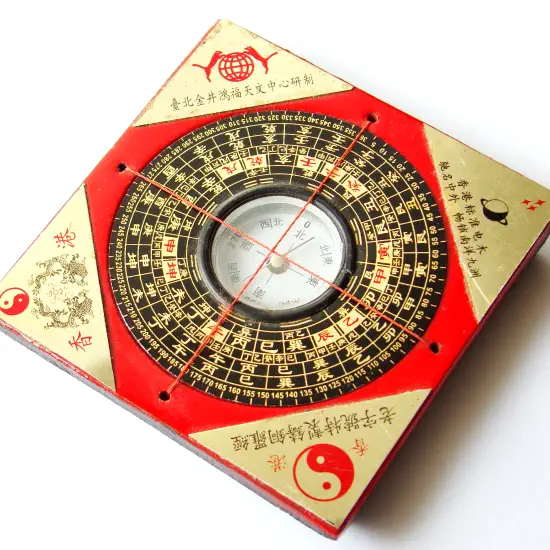
The Luo Pan compass or lo pan in Feng Shui is a circular disc made of wood, typically measuring around 12 to 24 inches in diameter. It features multiple concentric rings with inscriptions and markings representing various aspects of Feng Shui. The central point of the compass is known as the heaven dial or celestial plate, while the outer rings represent different cardinal directions, stars, constellations, and other celestial bodies.
It’s noteworthy to point out that the word “compass” in Chinese literally translates to “needle facing south.” Consequently, the luo po points south instead of north, in contrast to the western compass.
Feng Shui practitioners, or geomancers, use the luo pan to determine the precise orientation and alignment of a structure or building, allowing them to assess and analyze the energy flow, or Qi, in a particular location.
To use it, one typically stands at the center of the desired location and holds the compass flat, allowing it to rotate freely. By observing the alignment of the compass needle with the inscriptions and markings, they can interpret the energy patterns and make informed recommendations.
Brief Overview of the Most Important Luo Pan Rings:
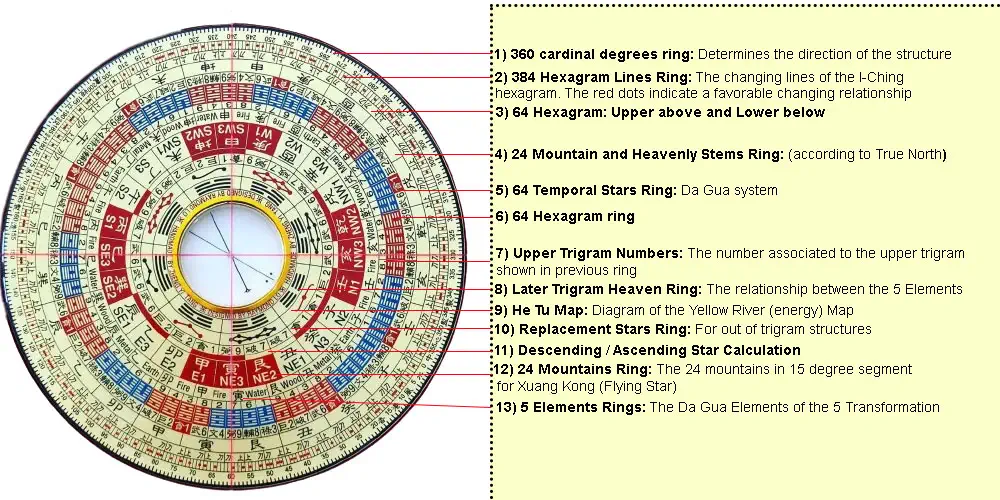
Early Heaven Trigram Ring
This ring on the Feng Shui luo pan reflects the Early Heaven trigram, which is a fundamental concept based on the ancient Chinese philosophical system known as the I Ching, or Book of Changes.
The Early Heaven trigram consists of eight unique symbols, known as trigrams, arranged in a specific order. Each trigram represents a combination of three solid or broken lines, symbolizing the interaction of Yin and Yang energies. The eight trigrams are Qian (Heaven), Kun (Earth), Zhen (Thunder), Xun (Wind), Kan (Water), Li (Fire), Gen (Mountain), and Dui (Lake).
The He tu or River Yellow Map
The He Tu map is a symbolic diagram in Chinese culture that consists of a grid of ten solid and hollow dots, each containing numbers arranged in a specific energy pattern. It is associated with ancient Chinese cosmology and the principles of Yin and Yang. The numbers reveal the astronomical relationships between planets, with the emperor star yellow 5, in the center.
Star 5 is often called the all-mighty “above all” force that controls everything in our universe. The He Tu map is used in various divination practices and is believed to reveal insights into the flow of Qi (energy) and the balance of elements.
Early Heaven Trigram Ring
This ring on the luo pan reflects the Early Heaven trigram, which is a fundamental concept based on the ancient Chinese philosophical system known as the I Ching, or Book of Changes.
The Early Heaven trigram consists of eight unique symbols, known as trigrams, arranged in a specific order. Each trigram represents a combination of three solid or broken lines, symbolizing the interaction of Yin and Yang energies. The eight trigrams are Qian (Heaven), Kun (Earth), Zhen (Thunder), Xun (Wind), Kan (Water), Li (Fire), Gen (Mountain), and Dui (Lake).
Replacement Stars Ring
In certain cases, there are specific cardinal direction lines where a structure falls “out of trigram,” resulting in continuous switching between two distinct energies. This can lead to instability in terms of the flow of Qi within the home. For instance, if the compass reading during construction, taking into account magnetic declination, aligns precisely with 202.5 degrees, which is the boundary between South 3 and SW1, we can call this borderline structure “out of trigram”.
When faced with such a scenario, experienced consultants employ the replacement star method to calculate the flying star chart or energy map of the home. This method helps to determine the energetic influences and optimize the Qi flow within the space.
Later Heaven Trigram Ring
The Later Heaven trigram is widely acknowledged and utilized in the flying star practice due to its representation of the relationship between the five elements, illustrating a productive cycle, with the exception of the Northeast and Southwest directions.
Additionally, there is a notable and significant relationship between the gravitational pull and the linear energy flow of the Earth from the northeast to the southwest. This specific straight energy line forms a distinctive magnetic axis that possesses its own unique energetic characteristics.
The Water Dragon Ring
The primary objective of the San He water dragon formula is to guide the flow of Qi by utilizing the presence of real or symbolic water. The intention is to channel the beneficial Qi from a favorable direction into the house and let it exit at an unfavorable location. It is important for the water flow to be gentle and slow, with particular emphasis on the placement of the water at the front of the structure.
Given the directional nature of the water flow, the key focus is on the 24 mountain (shan) rings. The first plate, known as the ti pan or earth plate, is utilized to determine the sitting direction of the building. On the other hand, the third plate, called the t’ien pan or heaven plate, is used to measure the directional movement of the water dragon, both incoming and outgoing. The main purpose of this application is to enhance prosperity and abundance within the home.
Yin House Rings
Some of the rings belong to San He mainly used for the Feng Shui yin house application to determine the most auspicious burial site for a deceased family member. These rings give a good insight of how mountains, hills, rivers, or any kind of manmade features might interfere with the qi flow toward the grave.
64 Hexagrams Rings
The Xuan Kong Da Gua method is a branch of classical Feng Shui that corresponds to 64 directions depicted as hexagrams from the i-ching book of changes. It can complement the flying star school by fine-tuning the star energies, narrowing them to a 5-degree angle. The system relies on the Early Heaven sequence (Xian Tian Ba Gua) of trigrams derived from the Heu transformation. The one-degree sentiment of the lines (kinships) shows their characteristics and if they are in a favorable changing relationship.
Numerous practitioners utilize the 64 hexagrams to ascertain whether a door or window aligns with a favorable 5-degree section. However, there exists a considerable divergence of opinions regarding this matter. Some fervently believe that adjusting the position of a door to align with a more auspicious hexagram will be beneficial, while others vehemently disagree, basing their stance on the scientific principles of qi flow.
A simplified approach to interpreting a sector’s hexagram involves combining the energy pair by positioning the mountain star at the bottom and the water dragon at the top. Since each hexagram of the I-Ching contains a distinct spiritual guidance message, a practitioner can carefully examine its message and interpret it with regard to significant aspects of a home, such as the front door, sitting, or the facing orientation of the dwelling.
Let me provide you with an example: Suppose a client has their front door located in the southern section with the flying star pair of 6–9. This alignment corresponds to the I-Ching hexagram #14, also known as “Ta Yu Great Possessing” or “Great Harvest.” This hexagram symbolizes an overall sense of positivity, suggesting that the residents will experience remarkable success, achievements, wealth, and prosperity.
Furthermore, the client’s home sitting degree aligns with hexagram #46 (Shēng, Earth over Wind). This hexagram signifies that the seeds have been planted, and now they need to patiently wait for the tree to grow. In simpler terms, it implies that the client should exercise patience in their daily life, remain grounded, and avoid overconfidence.
I have come across numerous remarks made by fellow practitioners who have bought specific books, expressing their ongoing confusion regarding harnessing the full potential of the compass. To maximize its effectiveness, it is crucial to first fully understand the fundamental techniques employed by various schools.
Since the luo pan incorporates elements from different schools like Xuan Kong Flying Star, Xuan Kong Da Gua, San He (Three Harmony), and Yin Feng Shui, it becomes imperative to thoroughly study the principles of each school in order to apply them effectively in practice.
STRANGE NEEDLE 8 METHODS 奇針八法
In modern times, the Chinese Luopan 羅盤 is predominantly utilized for measuring directions in Feng Shui practices. However, ancient Feng Shui masters also documented eight behavioral patterns of the Luopan needle, known as Qi Zhen Ba Fa 奇針八法 or “Strange Needle 8 Methods.”
During a Feng Shui audit, the Luopan needle’s behavior reveals valuable insights about the house and its relationship with the surrounding ground, indicating specific situations or conditions. It serves as a useful tool for understanding the energy dynamics of the underlying soil of the structure.
Interested to learn classical Flying Star for Beginners: Flying Star Feng Shui Course
Luopan needle behavior: House dynamics and its impact on residents
Tang Zhen 搪針: The Swiveling Needle
Needle Behavior: The needle keeps swaying left and right without stopping.
Reason: Strange rocks lie buried beneath the house.
Possible Implications: Staying in the house with a swaying needle at the Xun, Si, or Bing 巽巳丙 mountain positions may cause calamity or disaster. Buried nine feet underground are old or antique objects, and living there may result in women inclined towards drinking and promiscuity, impoverished, lonely widows, or witches.
Dui Zhen 兌針: Floating Needle
Needle Behavior: The needle tip rises and floats upward
Reason: A good-kinded yin qi spirit is present
Possible Implications: If not ancestors, a benevolent deity may be lingering around the house.
Chen Zhen 沉針: Sinking Needle
Needle Behavior: Needle tip sinks downwards
Reason: A evil and wicket yin qi spirit is present
Possible Implications: The presence of a spirit or ghost who died unjustly or unnaturally lingers, leading to discomfort among the house’s occupants.
Zhuan Zhen 轉針: Rotating Needle
Needle Behavior: Needle is rotating nonstop
Reason: A vengeful evil spirit hovers relentlessly with deep hatred.
Possible Implications: Inhabitants of this house will encounter injury or harm.
Tou Zhen 投針: Pitching Needle
Needle Behavior: Needle is pitching up and down nonstop (It hovers midway and descends midway)
Reason: Old tombs lie buried beneath the ground.
Possible Implications: Residing in such a location will undoubtedly invite sorrowful occurrences and necessitate guarding against lawsuits or gossip.
Ni Zhen 逆針: Opposite Needle
Needle Behavior: The needle cannot align with the center-line and might tilt to one side.
Reason: Electromagnetic energy field is not stable
Possible Implications: Inhabitants of this place will become rebellious, leading to negative effects on both individuals and wealth. Such a location lacks any significant Feng Shui considerations.
Ce Zhen 側針: Side Needle
Needle Behavior: The needle stopped but couldn’t remain on the center-line
Reason: Too much yin in soil
Possible Implications: The ground is suitable for a temple, mosque, or church, but not for residential purposes.
Zheng Zhen 正針: Correct Needle
Needle Behavior: Needle is steady and is not slanted in anyway.
Reason: good qi residing in soil
Possible Implications: This ground soil is ordinary and can be further evaluated for Feng Shui evaluations.
During your next Feng Shui audit, make sure to take note of the needle’s behavior and, if needed, advise the client accordingly with the reason behind it and its implications.
Credit: Master Cyril first introduced the 8-needle method, or Qi Zhen Ba Fa, to the Western world in 2008.
Essential Care Tips for Feng Shui Luo Pan Compass
Taking care of the Feng Shui Luo Pan compass involves following a few essential practices:
- Handle with care: The Luo Pan is a delicate instrument, so it’s important to handle it with care to avoid any damage. Hold it by the central handle or grip it gently on the sides.
- Store in a safe place: When not in use, store the Luo Pan in a secure and protected location. Choose a clean, dry area away from direct sunlight, extreme temperatures, and excessive humidity to prevent any potential damage.
- Clean regularly: Regular cleaning is necessary to maintain the accuracy of the Luo Pan. Use a soft cloth or brush to remove any dust or dirt that may accumulate on the surface. Avoid using harsh chemicals or abrasive materials that could scratch or damage the compass.
- Avoid exposure to magnetic fields: The Luo Pan is sensitive to magnetic fields, so keep it away from strong magnets, electronic devices, and other sources of magnetic interference. Exposure to such fields can affect its accuracy and calibration.
- Use with clean hands: Before using the Luo Pan, ensure that your hands are clean and free from oils or substances that could transfer onto the compass. Oily or dirty hands may interfere with the smooth rotation of the compass needle.
By following these practices, you can help preserve the accuracy and longevity of your Luo Pan, ensuring that it remains a reliable tool for Feng Shui analysis and guidance.
Buying Guide for a good high-quality Luo Pan
When selecting a Luo Pan compass from the wide variety available on the market, it is best to identify the specific rings that suit your needs. Here are two important factors to keep in mind:
- Readability: Ensure that all the rings on the compass are easy to read. Excessive rings and symbols can lead to confusion and hinder accurate readings. Opt for a design that offers clear and straightforward markings to enhance your understanding.
- Size Matters: Find a compass that strikes the right balance in terms of size. A compact compass may lack the necessary rings for more comprehensive analysis and is better suited for basic use. Conversely, an oversized compass can become impractical during home visits due to the overwhelming number of rings. Look for a size that fits comfortably in your hand and provides the required rings without compromising usability.
In my opinion, Raymond Lo’s Luo Pan stands out as an excellent choice for both affordability and meeting the needs of professional practitioners. His compass, designed by the esteemed Grand Master himself, eliminates unnecessary rings that can cause confusion. It allows students and practitioners to fully benefit from its main features, providing all the essential elements required for effective Feng Shui analysis.

October 23, 2026
By FengShuiBalanz
With over 9 years of experience in classical Feng Shui, our expertise centers on Flying Stars and Form School. Trained by respected Grand Masters across Asia, the USA, and Europe, we’ve delivered expert consultations to hundreds of clients. Driven by a deep passion for guiding others, our approach emphasizes mentorship, helping individuals grasp the authentic teachings of Feng Shui. The teaching style is patient and approachable, blending traditional wisdom with practical, real-world strategies that deliver meaningful results.